
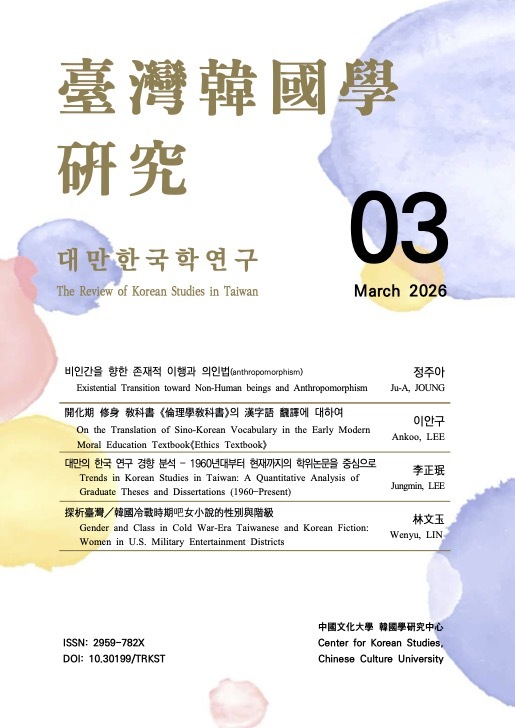
臺灣韓國學研究 3期
비인간을 향한 존재적 이행과 의인법(anthropomorphism) - 정주아
초록
이 글에서는 인간중심주의를 해체해야 한다는 생태론적 명제를 염두에 두고 최근 한국의 문학에 등장하는 탈-인간화의 기법, 즉 의인법에 초점을 두어 살펴 보았다. 인간에게 인간이 아닌 존재의 몸과 감각을 주어 세상을 경험하게 하는 문학적 상상력은, 인간이 인간중심적인 한계를 벗어날 수 있었던 전통적인 방식 중 하나이다. 전통적인 의인법은 인간의 이성이 동물의 몸에 그대로 이식되는 방식으로, 동물의 몸을 한 채로 인간의 사고 방식을 전유하는 방식으로 표현된다. 인간의 모습을 닮은 동물들이 인간의 행동과 습성을 따라하는 데에서, 인간이 인간의 속성을 거리를 둔 채 살펴보게 되는 것이다. 그러나 최근 생태론적인 문맥에서 등장하는 ‘인간-동물’, ‘인간-식물’의 존재들은 그 성격이 다르다. 이러한 변이태들은 공통적으로 인간이라는 자의식이나 이성을 완전히 버리고, 인간이 아닌 다른 존재로 이행해가는 중간 존재자들로 나타난다. 이 글에서는 김엄지와 한강의 소설을 읽으면서, 생태론적 시야의 확장과 더불어 의인법이 인간의 비인적 존재로의 이행에 있어 변이의 성격을 표현하는 데 쓰이고 있음을 살펴보았다. 생태주의 시대의 의인법이란, 언어라는 인간적 도구로 사유할 수밖에 없는 인간이 탈인간주의를 구현하기 위해 도달할 수 있는 사유의 최대치이자 한계 지점이라 할 수 있겠다.
주제어
의인법, 생태주의, 김엄지, 한강, 인간중심주의, 탈인간중심주의
Existential Transition toward Non-Human beings and Anthropomorphism - Ju-A, JOUNG
Abstract
This study explores the evolving technique of anthropomorphism in recent Korean literature, framed by the ecological necessity of dismantling anthropocentrism. Historically, giving humans the sensory experiences of non-human beings was a method used to escape anthropocentric boundaries. However, traditional anthropomorphism often remained limited, as it merely superimposed human reason onto animal forms, keeping human cognitive structures intact. In contrast, the “human-animal” and “human-vegetal” figures in contemporary ecological narratives represent a significant shift. These figures function as liminal beings who relinquish human rationality to undergo a complete transition into the “Other.” Through an analysis of novels by Kim Um-ji and Han Kang, this article argues that contemporary anthropomorphism serves as a vehicle for radical variation and ecological expansion. Ultimately, this mode of anthropomorphism marks the furthest point human thought can reach in its attempt to achieve true dehumanization while still operating within the limitations of human language.
Keywords
anthropomorphism, ecology, Kim Um-ji, Han Kang, anthropocentrism, dehumanization
開化期 修⾝ 敎科書《倫理學敎科書》의 漢字語 飜譯에 대하여 - 이안구
초록
본고에서는 일본의《新編倫理敎科書》를 저본으로 하는 신해영의 《倫理學敎科書》(1906)를 대상으로 하여 일본어 원문의 한자어가 번역되는 양상을 살폈다. 개화기에는 서구 근대 문물의 도입으로 신생 한자어들이 다수 유입되었는데 개화기의 신생 한자어들은 비교적 쉽게 국어 어휘 체계에 수용되는 경우도 있지만 전통 한자어나 다른 신생 한자어들과 공존하며 경쟁하다가 점진적으로 정착하기도 하며 의미 변화를 겪기도 한다. 본고에서는 《倫理學敎科書》와 그 저본이 되는 일본어 문헌을 비교하여 개화기 신생 한자어가 일본어 원문 그대로 사용되는 경우, 일본어 원문의 신생 한자어가 전통 한자어로 번역되는 경우, 신생 한자어와 전통 한자어가 공존하는 경우, 비슷한 의미의 신생 한자어들이 공존하는 경우 등으로 나누어 각각 몇 가지 예를 검토하였다. 《倫理學敎科書》와 같이 일본의 문헌을 저본으로 하는 개화기 번역 텍스트는 일본어를 통한 한자어의 수용과 변용, 서구 신문물의 도입 과정에서 나타나는 한자어의 과도기적 양상을 살필 수 있다는 점에서 상당한 의의를 지닌다. 뿐만 아니라 《倫理學敎科書》는 개화기 어휘 연구에 있어서 아직 충분히 검토가 이루어지지 않은 추상명사들이 많이 쓰이고 있다는 점에서 매우 의미 있는 자료라 할 수 있다.
주제어
《倫理學敎科書》, 번역 텍스트, 개화기 신생 한자어, 한자어의 수용과 변용
Abstract
This study examines the Ethics Textbook (1906) by Shin Hae-young, which is based on the Japanese New Edition Ethics Textbook, while also investigating how Sino-Korean terms from the Japanese original were translated. During the early modern period of Korea, the introduction of Western modern civilization led to the influx of numerous newly coined Sino-Korean terms. While some of these new terms were readily integrated into the Korean lexicon, others coexisted and competed with traditional Sino-Korean words or alternative newly coined Sino-Korean terms, gradually becoming established or undergoing semantic changes. By comparing the Ethics Textbook with its Japanese source text, this study categorizes translation patterns into several types: case in which newly coined Sino-Korean terms were adopted directly from Japanese original; cases where such terms were translated into traditional Sino-Korean equivalents; cases in which both new and traditional Sino-Korean terms coexisted; cases where newly coined Sino-Korean with similar meanings coexisted. Each of these pattern is examined in detail to elucidate the dynamic process of linguistic adaptation in the early modern Korea. Early modern translated texts based on Japanese sources offer valuable insights into the transitional features of Sino-Korean vocabulary in the introduction of Western civilization, as well as the patterns of adoption and adaptation of Sino-Korean terms via Japanese. The Ethics Textbook serves as a significant resource for studying the vocabulary of early modern Korea, as it contains many abstract nouns that have not yet been sufficiently examined.
Keywords
《Ethics Textbook》, translated text, early modern Sino-Korean terms, adoption and adaptation of Sino-Korean terms
대만의 한국 연구 경향 분석 - 1960년대부터 현재까지의 학위논문을 중심으로 - 이정민
초록
본 연구는 대만 교육부의 학위논문 데이터베이스에 수록된 1960년부터 2023년까지의 한국 관련 논문 1,023편을 대상으로 대만 내 한국 연구의 경향을 양적으로 분석하였다. 1992년 한국과 대만 단교로 공식적인 외교 관계는 단절되었으나, 학계를 중심으로 한 비공식적 교류와 연구는 꾸준히 지속되어 왔다.
분석 결과, 대만의 한국 연구는 크게 여명기(1960~1980), 맹아기(1981~1999), 발전기 (2000~현재)의 세 시기로 구분된다. 여명기는 연간 1~2편에 불과했으나 한국 연구의 기초를 다진 시기였으며, 맹아기에는 단교라는 악재 속에서도 연구가 점진적으로 증가하였다. 발전기에는 한국에 대한 관심이 폭발적으로 늘어나며 경제 성장, 콘텐츠 산업, 한류 등을 중심으로 연구가 활발히 전개되었다.
주제별로는 상업 및 경영학, 사회행동과학, 인문학 분야의 연구가 두드러졌다. 특히 삼성, 현대, LG 등 대기업을 위시한 한국의 경제 모델과 산업 발전, 그리고 드라마와 K-POP 등 한류 콘텐츠가 주요 연구 대상이었다. 이는 대만에서의 한국 연구가 단순한 지역학적 관심을 넘어, 한국의 성공적인 경제, 문화 모델을 벤치마킹하려는 실용적 목적에서 수행되었음을 시사한다. 앞으로도 이러한 실용적 관점의 연구 경향은 지속될 것으로 전망된다.
주제어
대만의 한국연구, 해외한국학, 한국연구 동향, 한류
Abstract
This study provides a quantitative analysis of the trends in Korean Studies in Taiwan, focusing on graduate theses and dissertations. Although official diplomatic relations between South Korea and Taiwan were severed in 1992, non-governmental academic exchanges have persisted. Notably, Taiwanese academia has maintained a consistent interest in Korea as a subject of research. To analyze these trends, this study examines 1,023 theses and dissertations related to Korea, sourced from the National Central Library of Taiwan’s database, covering the period from 1960 to 2023.
Korean Studies in Taiwan can be categorized into three distinct periods: the nascent phase (1960–1980), the formative phase (1981–1999), and the developmental phase (2000–present). The nascent phase, characterized by the early stages of the bilateral relationship, saw limited output with only one or two theses published annually; nevertheless, this era laid the foundational framework for future research. During the formative phase, the volume of research gradually increased, sustaining momentum even amidst the diplomatic rupture in 1992. The developmental phase witnessed an exponential surge in interest, driven primarily by Korea’s economic growth, content industry, and the Korean Wave (Hallyu, 한류).
Chronological analysis reveals that research has been predominantly concentrated in the fields of Business and Management, Social and Behavioral Sciences, and the Humanities. Scholarship was not confined to Korean language departments but expanded across diverse academic disciplines. Specifically, the Korean economic model, industrial development, and cultural content emerged as primary areas of interest. Corporate studies focused heavily on major conglomerates (chaebols, 재벌) such as Samsung, Hyundai, and LG, while research on the Korean Wave diversified into areas including K-dramas, popular music, and idol fandoms.
The findings suggest that Korean Studies in Taiwan has been underpinned by a pragmatic perspective, interpreting Korea’s economic and cultural trajectories as models for benchmarking. Despite the absence of formal diplomatic ties, Korea remains a significant subject of inquiry for Taiwanese scholars, a trend that is projected to continue in the future.
Keywords
Korean Studies in Taiwan, Overseas Korean Studies, Trends in Korean Studies, Korean Wave (hallyu)
摘要
本研究探討戰後臺韓社會變遷下,臺灣「吧女」與韓國「洋公主」如何在冷戰局勢與戰爭經濟運作下,淪為受迫的邊緣群體。文中分析臺灣黃春
明〈小寡婦〉、曾心儀〈酒吧間的許偉〉與韓國李範宣〈誤發彈〉、南廷賢〈糞地〉,探究女性在經濟困境、社會污名與家庭崩解中的掙扎。這群女性因美軍駐紮而進入特種行業,既承載殖民與戰爭的創傷,亦深受資本體系剝削。文學作品對此發出控訴,反思社會的不公批判及戰爭對女性的結構性壓迫。本文聚焦於其生命困境與焦慮,透過描繪貧困與生離死別下的破碎家庭,深刻突顯種族、經濟與性別交織的嚴肅議題。
關鍵字
吧女、洋公主、性別、階級、女性文學
Abstract
This study explores how Taiwan's "bar girls" and Korea's "Western princesses" (Yanggongju) became marginalized groups under the influence of the Cold War and the war economy amidst post-war social changes. By analyzing Huang Chun-ming’s The Little Widow (Xiao Guafu) and Tseng Hsin-yi’s Hsu Wei in the Bar (Jiubajian de Xu Wei) from Taiwan, alongside Yi Beom-seon’s The Aimless Bullet (Obaltan) and Nam Jeong-hyeon’s Land of Excrement (Bunji) from Korea, this paper investigates women's struggles with economic hardship, social stigma, and family disintegration.
Entering the special entertainment industry due to the stationing of U.S. troops, these women bear the trauma of colonial and war legacies while being deeply exploited by the capitalist system. These literary works indict this injustice, reflecting on unfair social criticism and the structural oppression of women by war. Focusing on their predicaments and anxieties, this paper highlights the serious intersecting issues of race, economy, and gender through the depiction of broken families suffering from poverty and bereavement.
Keywords
Bar girls, Western princesses (Yanggongju), Gender, Class, Women's literature
ISSN: 2959-782X
DOI: 10.30199/TRKST